Showing posts with label blood diamond war. Show all posts

Monday, November 19, 2012

Filming wraps in Freetown

Co-director Ngardy Conteh (in profile) and cinematographer Colin Akoon prepare to film inside a player's home, a windowless 64-square-foot room. 
Leone Stars just wrapped up filming in Sierra Leone.  The fourth and last shoot took place earlier this month in steamy weather, topping 42C each day and 36C at night on the humidex, mostly in the capital of Freetown.  For nearly two weeks, co-directors Ngardy Conteh and Allan Tong with cinematographer Colin Akoon and local fixer Hashmiyun Magona filmed various amputee soccer players at their homes and workplaces, streets and villages.  Here are some images from the shoot:
The Freetown team sqaures off against the Bo team on their turf, in the interior of the country.  Final score: 1-1.
Freetown captain, Bornor, training to be a generator repairman.  
Almost all Sierra Leoneans run diesel-powered generators, because the electric grid is so unreliable.

Cinematographer Colin Akoon mounts a light steadicam unit to the back of a moving motorcycle taxi ("okada") 
to follow an amputee also travelling by okada.


Mohammed of Freetown's team being interviewed in his office, owned by a German company.  
Mohammed supports a young child alone.


The aunt of the Bo provincial team captain, Umaru, interviewed as she cooks in her smoky hut.  
From top left to lower left: intern Amanta, cinematographer Colin Akoon, fixer Hashmiyun "Hash" Magona 
and co-director Ngardy Conteh.

Following Bornor's weekly jog from the back of our Toyota 4x4.  
Amid traffic, Bornor runs for one hour from his home in Freetown's Leceister Peak to Aberdeen Beach.


The steering wheel of a mini-bus in Freetown.
Cinematographer Colin Akoon panning atop a hill near Fort Street in downtown Freetown.  
In one minute, he will be covered in heavy rain.
Fixer extraordinaire, Hashmiyun "Hash" Magona
A shantytown in overcrowded Freetown where few enjoy running water and where cholera struck last summer.
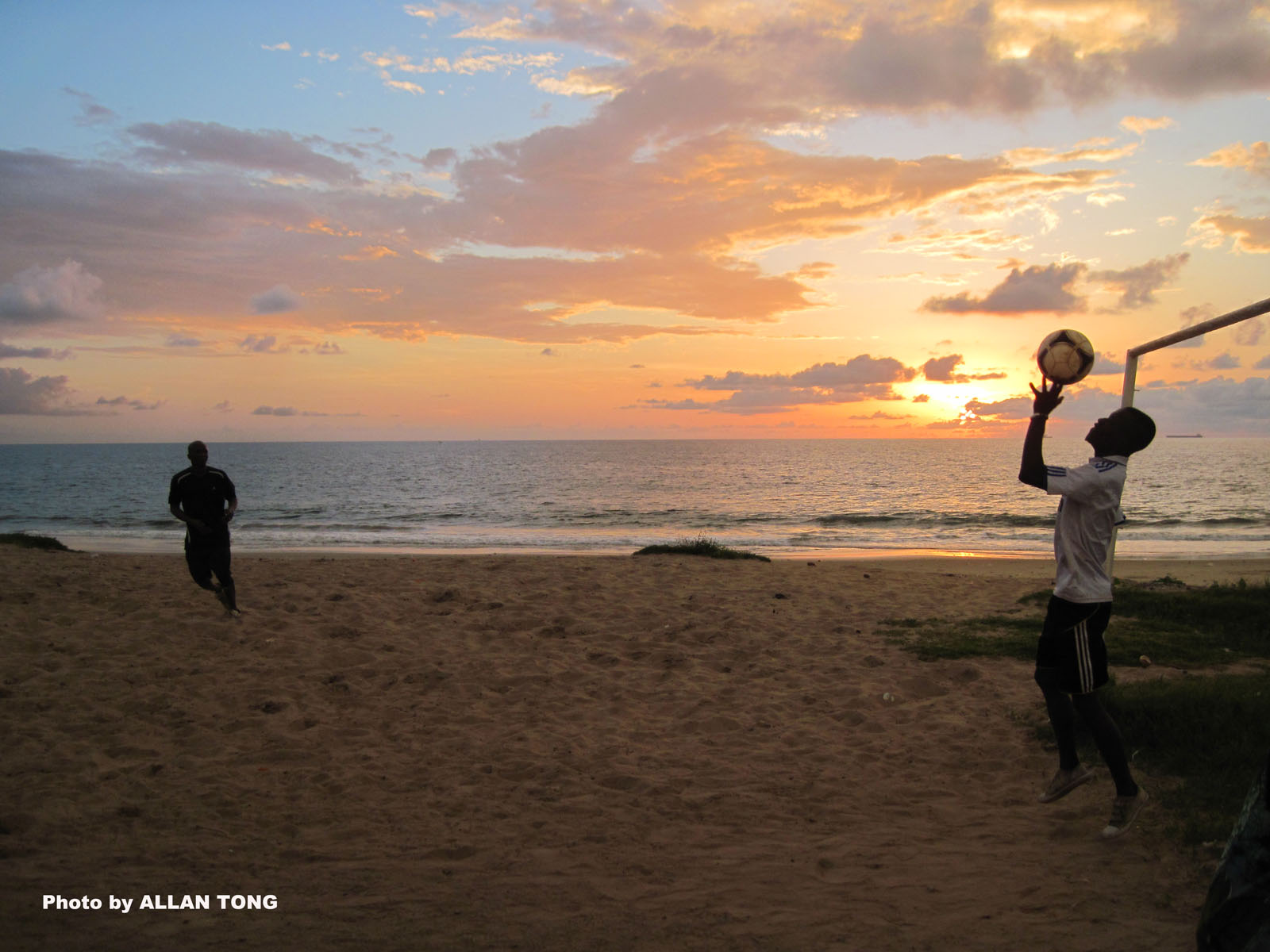
The sun sets over Aberdeen Beach as the Freetown amputees wind down their Sunday practice.


All photos by Allan Tong and cannot be reproduced without Allan's strict permission.


Monday, February 28, 2011

7 Things You Should Know about Sierra Leone

Chances are you don't know anything about Sierra Leone except that it's somewhere in Africa. This post is to teach you the basics of this nation, where our film crew is heading from
March 15 to 30. Some here are some tidbits you should know:


1) Sierra Leone is roughly the size and population of the Golden Horseshoe
of southern Ontario.


2) The country was once a British colony and the hub of the transatlantic slave trade.

3) The hills surrounding what is now Freetown Harbour were called Serra de Leão by early Portuguese explorers, meaning "Lion Mountains." That's how the country got its name.


4) Like many African countries, Sierra Leone is divided into a rainy season (from May to November) and a dry season (December to April). That's why our crew has chosen to
film in March.

5) Based on per-capita GDP (the wealth of a nation divided by population), Sierra Leone is often ranked the poorest or second-poorest country on Earth.

6) Ironically, Sierra Leone is one of the top 10 diamond-producing nations in the world.

7) Diamonds played a key role in the bloody civil war of 1991-2002. The amputee soccer team lost their limbs during those dark years, and that era is the focus of the film, LEONE STARS.


Thursday, February 24, 2011

10 Questions for Director Ngardy Conteh

1) First, how do you pronounce your name?
I always tell people it’s like "Daddy." but with a ‘G’. The ‘N’ and ‘R’ are silent. My name is traditional spelt "N’gadie," "Ngadie" or "Ngady," but my father (who was a linguist) altered the spelling of my name, as he did with all my siblings.


2) What's your connection to the subjects of this film?
I was born in Freetown, Sierra Leone to Sierra Leonean parents. You can say the subjects of the film are my countrymen.


3) How did you get from Sierra Leone to Canada?
My father came to Canada to pursue his PhD at the University of Toronto on a Commonwealth Scholarship, he brought my family with him when I was three-years-old


4) Who will you film in Sierra Leone?
We will film a range of people, but the focus will be on the players on the single-leg amputee soccer team.


5) What do you wish to learn from them?
I want to learn how they are have been able to adapt to life post-war, what is the driving force behind their desire to be a part of the team. How playing soccer has helped them transcend the obstacles in their lives.


6) Beside the capital of Freetown, will you film elsewhere in Sierra Leone?
We plan on traveling to the villages of Bo and Mattru Jong, and possibly another village, the plans are unfolding each day.


7) What will the climate and conditions be like in SL?
What do you expect to see and feel when you set foot on SL soil?
SL is gearing up to celebrate their 50th anniversary of independence at the end of April, so I imagine the vibe with be very positive getting ready for the celebrations. There has been lots of re-building over the years since the end of the war but there is still a lot to be done.
I’m not sure how I will feel, I’ve imagined this moment for so many years, excitement definitely. I don't have any childhood memories of Sierra Leone so I am hoping just the smells and sites of Freetown will trigger memories.


8) How did you find your director of photography, Colin Akoon?
Colin and I worked several years ago on a television documentary series. He was the DP and I was directing a few episodes. We worked very well together. I trust in his creative skills, and instinct and I always wanted to work with him again if the opportunity arose.


9) How's your family helping you with this shoot?
Myself and the crew will be staying with my extended family while in Freetown and in the villages. They have leant their support and knowledge thought this whole process, especially my mother. The Sierra Leone community in Toronto has also been very helpful as well.

10) What's the theme behind this film? The message?
Belonging. Hope. Strength. Resilience. Finding dignity and belonging through sports.


Tuesday, June 15, 2010

The Leone Stars play in Spain

The Leone Stars played in Spain last month, thanks to a generous donation from a cell phone company.

AllAfrica.com reports:

One of the leading mobile phone giants in the country, Africell, continues their relentless support towards football in the country with the donation of US$6,000 to the Single Leg Amputee Sports Club, ahead of their international trip to Spain.

Before handing over the cheque which equivalent to Le32.7 million, Africell's head of event and sponsorship, Arthur Kallon said supporting the single leg football team is no a difficult assignment for them as they've done several times in the past. He said: "In Africell we are committed in reaching our target, if we are supporting the two legged football in the country we see no reason why we should not support the single legged. This is not the first and will not be the end of our commitment to supporting sports in the country. We will continue to do more."

Photo by Fiona Aboud

President of the Amputee Sports Club, who also doubles as the team's goalkeeper, Jabati Mambu said he was pleased with the response from Africell, adding that this was not the first time the company has come to their aid.

He said: "Since we started this club in 2001, Africell has been our lead supporter. We thank them for this and will continue to pay them back, which is our obligation."According to Mambu, despite getting less support from Sierra Leoneans, the team has achieved and will continue to achieve lots of excellence internationally.

Before their departure yesterday with a 14-man delegation, the team's public relations officer, Albert Mustapha said their trip to Spain came after they received an invitation from three different sporting bodies from the European nation, including One Goal Association, NGO Esport Solidari International in collaboration with the Spanish Ministry of Sports and other sporting associations in that country.

He said during their stay, the team will participate in a tour of promotion for peace and sports in Barcelona, Burgos and Cadiz cities.

Tuesday, May 4, 2010

demo footage by Associate Producer, Fiona Aboud


Some sample footage of the Leone Stars amputee football (soccer) club, shot in 2007 by associate producer and New York photographer, Fiona Aboud